
ROOFING KNOWLEDGE
Commercial Flat Roof Winter Damage in Alberta: What Property Owners Should Watch For
By Markit Roofing • Calgary & Edmonton
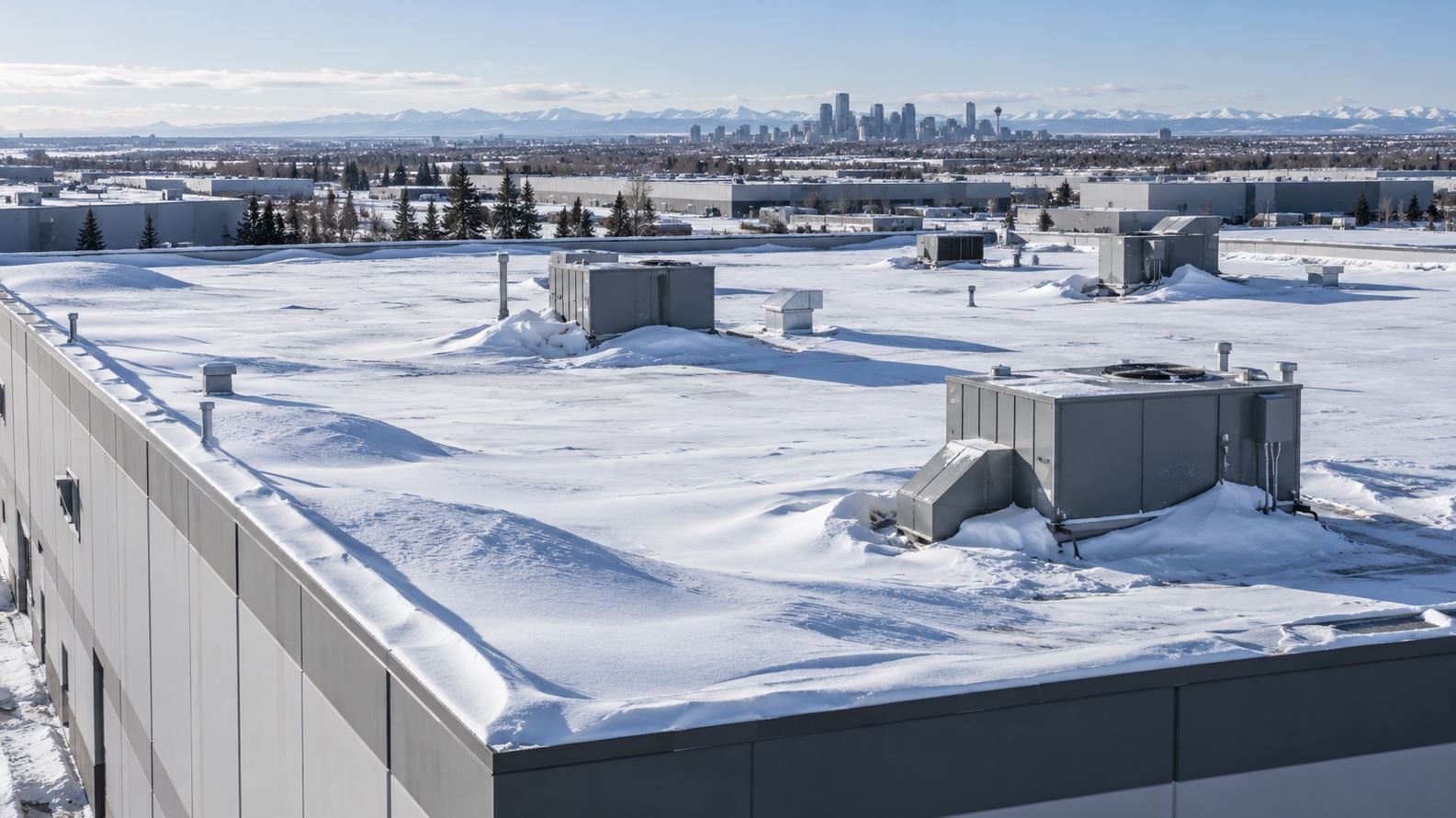
Snow drifting around rooftop equipment creates uneven loads.
An Alberta winter damages commercial flat roofs in ways that rarely announce themselves. The failure is rarely simply snow sitting on the membrane. It is snow drifting unevenly against a parapet, melting from below and refreezing at a drain, seeping into a seam and expanding, or condensing on the underside of a cold deck. By the time a stain appears on a ceiling tile, the mechanism behind it has usually been running for weeks.
For anyone managing a warehouse, retail plaza, office building or industrial facility in Calgary or Edmonton, the useful knowledge is narrow: five winter mechanisms cause most commercial flat roof failures here, each with its own warning signs and its own sensible response. This article covers all five, plus a seasonal checklist and guidance on where the line sits between what you can monitor and what a qualified contractor needs to handle.
ON THIS PAGE
Snow Load: Drifting Matters More Than Depth
Most flat commercial roofs in Alberta carry snow well because they were designed to do so. Under the National Building Code of Canada, roof design begins from a ground snow load derived from decades of local weather records, and the basic roof load is generally taken as a proportion of that ground load, with a lower factor permitted for roofs fully exposed to wind. A uniform blanket of snow on a properly designed roof is usually within its engineered capacity.
The risk is uneven load. Prairie winters pair cold temperatures and moderate snowfall with persistent wind, which redistributes snow rather than leaving it flat.
Where Drifts Collect
Snow piles against parapet walls, behind rooftop HVAC units and mechanical screens, at roof level changes, and in any sheltered pocket. Those are precisely the locations where drift loads concentrate the weight the structure carries, with less margin than in the open field.
Why Depth Alone Misleads You
Two seasonal factors make snow load worse without changing what you see from the parking lot.
- Density, not depth, carries the weight. A Chinook or a midwinter thaw adds meltwater and rain to an existing snowpack, re-densifying it. The snow may look lower while weighing considerably more.
- Clearing can create the problem it was meant to solve. Snow shovelled from one section and piled onto another concentrates load where the roof never expected it.
Signs That Need Immediate Action
If you notice visible sagging or deflection, new cracks in interior drywall, doors or windows that suddenly bind, or creaking under load, treat it as urgent and keep people out of the affected area. Do not send building staff up to assess it. Judging accumulated load against a building’s design capacity is work for a qualified roofing contractor or a structural engineer, and it is a safety question before it is a maintenance one.
Ice Dams Form on Flat Roofs Too
Ice damming is widely treated as a residential problem. It is not. It occurs on commercial flat and low-slope roofs, and the consequences are often worse, because water held on a flat roof has nowhere to run.
How an Ice Dam Actually Forms
The driver is heat, not cold alone. Ice dams form when part of the roof becomes warm enough to melt the snow above it, typically through a combination of heat escaping from the building and the insulating effect of the snowpack itself. Snow is an effective insulator, so deep accumulation traps interior heat against the deck and encourages melting underneath. That meltwater travels to a colder edge, drain or scupper, refreezes, and forms a dam. Water then backs up behind the ice and works laterally under membrane laps, seams, and flashing details.
The Long-Term Fix Versus the Winter Fix
Because ice damming originates from heat loss and uneven roof surface temperatures, durable fixes are envelope fixes: continuous insulation, effective air sealing, and controlling where warm interior air reaches the deck. Those are not mid-January corrections. They do explain, however, why some buildings dam every single winter while a neighbouring property does not, and why a recurring winter ice problem deserves proper investigation rather than another season of chipping ice off a drain.
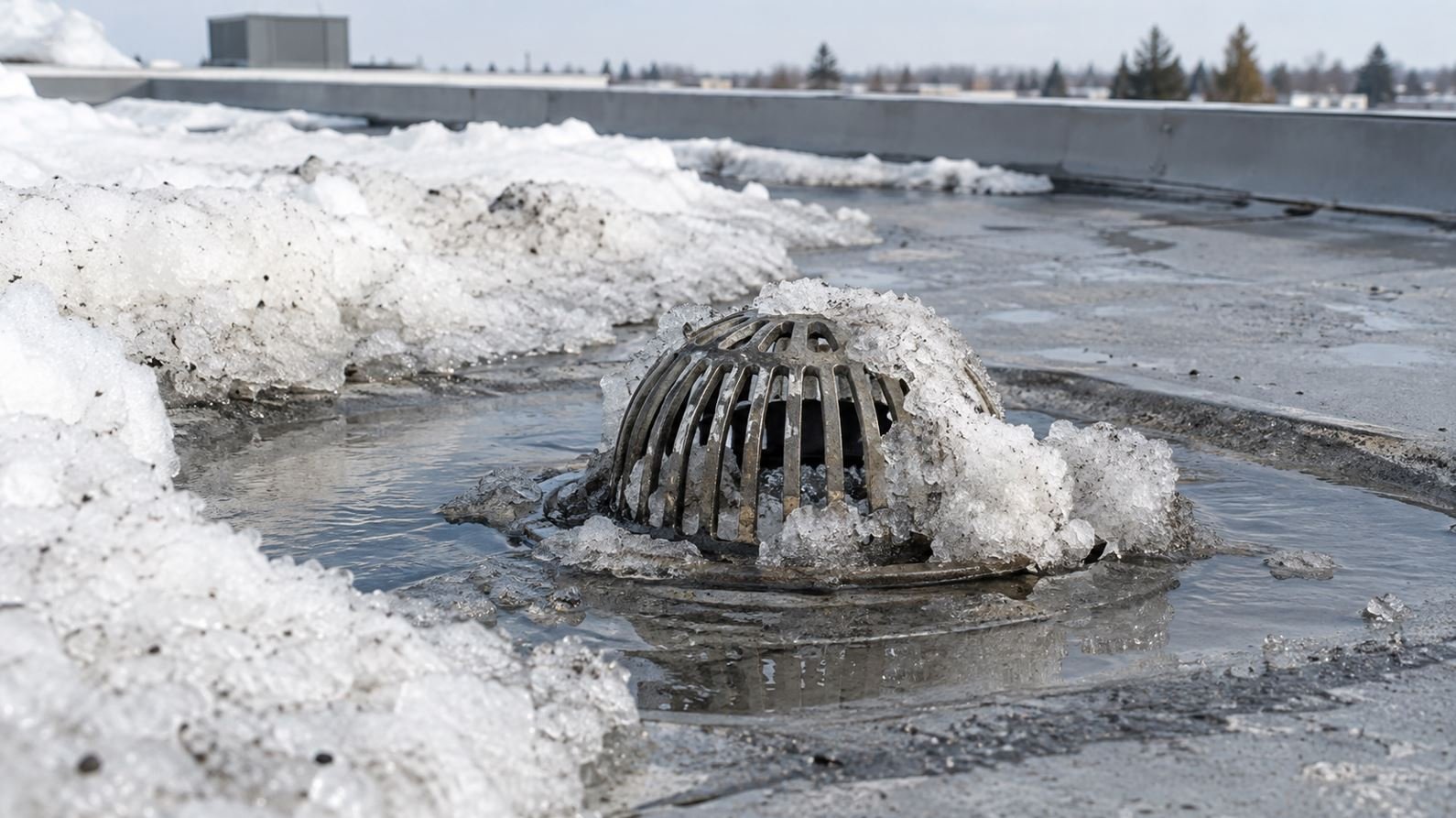
The most effective in-season defence is far simpler: keep water flowing off the roof. Clear drains, scuppers, and downspouts before winter and throughout it, so meltwater drains rather than ponding and refreezing behind an obstruction.
Ice at roof drains can trap meltwater on the membrane.
Freeze-Thaw Cycling: Damage That Accumulates Quietly
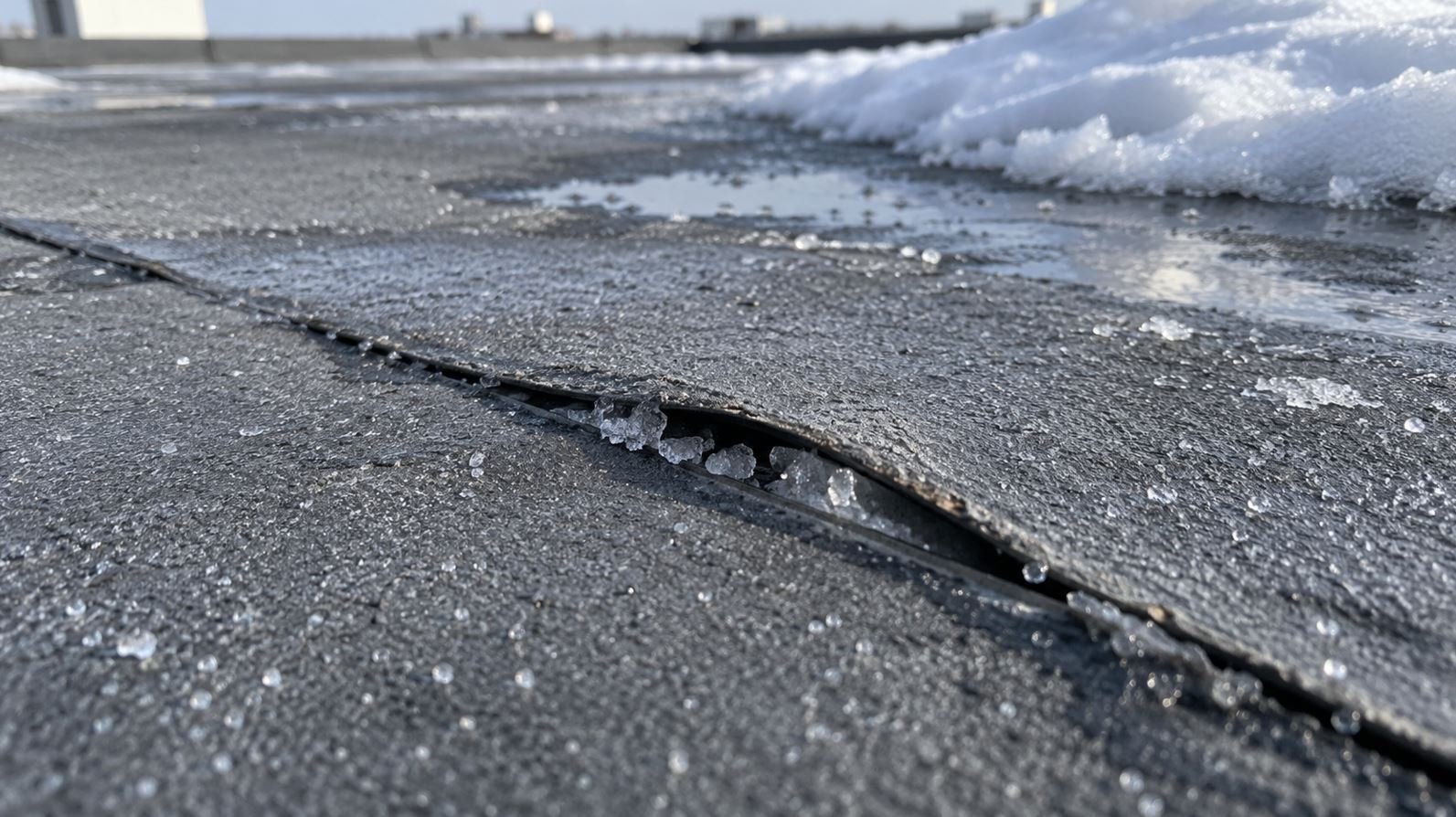
Calgary and Edmonton do not freeze in November and thaw in April. They oscillate. Chinooks and swinging temperatures push roofs through repeated freeze-thaw cycles all winter, and each cycle is a small stress event. Water enters a hairline crack, an open lap or a tired flashing detail, freezes, expands, then thaws, leaving the gap marginally wider than before.
Over the course of a season, this blisters and splits aging membranes, separates seams, and lifts flashing at parapets and curbs. It is the reason a roof can pass a November look-over and be leaking by March with no single storm to blame. Membranes near the end of their service life are most vulnerable, as are details around penetrations and rooftop equipment, where movement tends to concentrate.
Repeated freeze-thaw cycles can widen vulnerable membrane seams.
Winter Ponding: Blocked Drainage and Trapped Water
Flat roofs are not flat. They are built with a slope to drains and scuppers, and winter easily defeats that drainage. Snow and ice block drain bowls, meltwater collects in low spots, and the water refreezes in place instead of leaving.
Why Winter Ponding Is Worse Than Summer Ponding
Ponding damages a roof in any season. Winter compounds it three ways: trapped water adds weight during heavy melt, repeated freezing stresses the membrane exactly where water pools, and water that reaches the insulation saturates it, so it loses much of its effective R-value and the assembly deteriorates faster.
As a working benchmark, water that has not cleared a roof within roughly 48 hours of rainfall or melt is generally treated as ponding worth investigating rather than normal drainage.
Keeping drainage clear is the highest-value, lowest-cost winter intervention available to a commercial property. It is the backbone of Markit Roofing’s scheduled maintenance and repair work, which covers clearing drains and scuppers, checking slope, and correcting low spots before winter turns them into standing ice.
Condensation: The Winter “Leak” That Is Not a Leak
Not every winter drip is water coming through the roof. In cold weather, warm, humid interior air that reaches a cold surface within the roof assembly can condense, and that condensation can drip into the space below and be mistaken for a roof leak. Prolonged condensation can also support biological growth and corrode metal components and fasteners.
Air Movement Is the Usual Path
Moisture generally enters the assembly through air leakage rather than by passing through intact materials. Gaps at roof drains, penetrations, and transitions move far more moisture than the materials’ permeance does, which is why sealing those openings matters more than most owners expect.
Buildings Most at Risk
Properties with high interior humidity are more at risk, including food production facilities, laundries, indoor pools, and certain manufacturing operations. Chasing a membrane repair will not fix a condensation problem. Diagnosis is the point of a proper roof inspection and leak detection visit, which uses moisture detection alongside visual assessment to establish where water is actually coming from before anyone specifies a repair.
Where Winter Leaks Actually Begin
When a flat roof leaks in winter, water almost always enters at a detail rather than in the open membrane field. The recurring culprits are:
- Separated or split seams, where sheets meet, and freeze-thaw has broken the bond
- Cracked or lifted flashing at parapets, walls and curbs
- Roof penetrations such as vents, drains, HVAC curbs and skylights, where cold and movement have opened the seal
- Ice-blocked drainage, which forces water sideways and up under laps
- Condensation within the assembly, which presents as a leak but originates inside
These are small, high-consequence details. They are reliably found by inspection and unreliably by waiting.
A Practical Winter Checklist
Treat this as a seasonal rhythm rather than a one-off. Items marked professional are not appropriate for building staff to attempt.
Task
Timing
Who
Clear all drains, scuppers and downspouts
Before first snowfall, then through winter
Professional
Full pre-winter inspection: seams, flashing, penetrations, membrane
Fall
Professional
Watch for drifting behind rooftop units, at parapets and level changes
Ongoing
Owner or manager, from a safe vantage
Monitor interior warning signs
Ongoing
Owner or manager
Clear ice from drains and roof edges
During and after major snow or thaw events
Professional
Post-winter inspection for freeze-thaw damage
Spring
Professional
Photograph and document any storm damage
Immediately after the event
Professional
Interior Signs That Warrant a Call
New ceiling stains, damp patches near exterior walls, drips following a thaw, fresh stress cracks in drywall or around door frames, musty odours, or unexplained cold spots all justify booking an inspection rather than waiting for the next thaw.
A Word on Clearing Snow Yourself
After a heavy storm, it is tempting to send someone up with a shovel. Industry guidance is that rooftop snow removal should be attempted only where it can be done safely, and that tools with sharp edges should never be used to break up ice, as they can damage the roof covering. Skylights buried under snow are a particular hazard: they can be invisible and are not built to support a person’s weight. Where snow or ice cannot be safely cleared from ground level, the work is the responsibility of a qualified contractor.
Documenting Winter Damage Properly
If a storm damages your roof, the quality of the documentation determines what happens next. Dated photographs, a written description of findings, and a clear scope of work give an insurer something specific to assess and provide you with a record of the roof’s condition at a known point in time. Markit Roofing assists with commercial insurance claim documentation as part of its Alberta service offering. No contractor can promise a particular claim outcome, but an undocumented loss is considerably harder to substantiate than a documented one.
When Winter Damage Signals a Larger Decision
Sometimes a hard winter is simply the season the roof’s real condition becomes visible. If freeze-thaw keeps opening the same seams every year, or an inspection finds widespread membrane deterioration with saturated insulation beneath, continued patch repair may no longer represent the better value. That judgement should come from a documented condition report that weighs the roof’s age, system type, and repair history, which is the assessment underpinning the full range of commercial roofing services Markit Roofing provides across Alberta.
Where the membrane is worn, but the deck below remains sound, a roof coating or waterproofing system may extend service life without a full tear-off. Eligibility depends on the condition of the existing assembly and the manufacturer’s requirements for the specific product, so it is a spring conversation to have with a contractor rather than an assumption to make in advance.
COMMON QUESTIONS
Frequently Asked Questions
01 Should snow be removed from my flat commercial roof after every storm?
Not automatically. Most Alberta commercial roofs are engineered to carry substantial, uniform snow loads, so depth alone is rarely the trigger. Drifting, re-densified wet snow, and added rainwater are the real concerns. The sound approach is a professional assessment that judges whether accumulation genuinely warrants removal, then carries it out without damaging the membrane.
02 Do ice dams really form on flat roofs, or only sloped ones?
They form on both. Ice dams occur wherever heat loss and snow cover allow melting, followed by refreezing at a colder point. On a flat commercial roof, refreezing typically occurs at drains, scuppers, and edges, which block drainage and force water under seams and flashing, often with worse consequences than on a pitched roof because the water cannot simply run off.
03 Why does my roof leak during a thaw rather than during a snowfall?
Because most winter leaks are meltwater finding a route. During a thaw, snow melts faster than frozen or blocked drains can clear it, water backs up behind ice, and it travels under seams and flashing that freeze-thaw cycling has already weakened. The snowfall creates the conditions; the melt delivers the leak.
04 How can I tell a roof leak from condensation?
Not reliably from the ground, which is the honest answer. Condensation dripping from within the assembly looks very similar to a membrane leak from inside the building. Timing and location offer clues, since condensation problems tend to track cold snaps and interior humidity rather than precipitation, but properly distinguishing the two requires a professional inspection with moisture detection, as the remedies are entirely different.
05 How often should an Alberta commercial roof be inspected?
Common industry practice is twice yearly, in fall and spring, plus a check after any major storm. The fall visit prepares drainage and catches vulnerable details before the cold sets in; the spring visit finds what the winter left behind, while it is still a repair rather than a section replacement.
06 What does winter damage actually look like once it is found?
On the roof, an inspection may reveal a split or blistered membrane, separated seams, cracked or lifted flashing, damaged penetrations, and staining indicating where water has been ponding. Inside, it shows up as ceiling stains, damp walls, drips after thaws, and new stress cracks. A documented spring inspection is the dependable way to establish what a hard winter did.
PROTECT YOUR PROPERTY
Get Ahead of Winter Before It Reaches Your Ceiling
The least expensive winter roofing problem is the one found in the fall. If you own or manage a commercial property in Calgary, Edmonton, or the surrounding area, a pre-winter inspection and clear drainage go a long way toward preventing snow, ice, and freeze-thaw from causing an interior leak and an operational disruption.
To arrange an assessment or discuss a seasonal maintenance plan, book a consultation with Markit Roofing or reach the team through the contact page. Offices in Calgary and Edmonton serve flat and low-slope commercial roofs across Alberta.